

The Desert Training Ground
The Silence Before the Voice

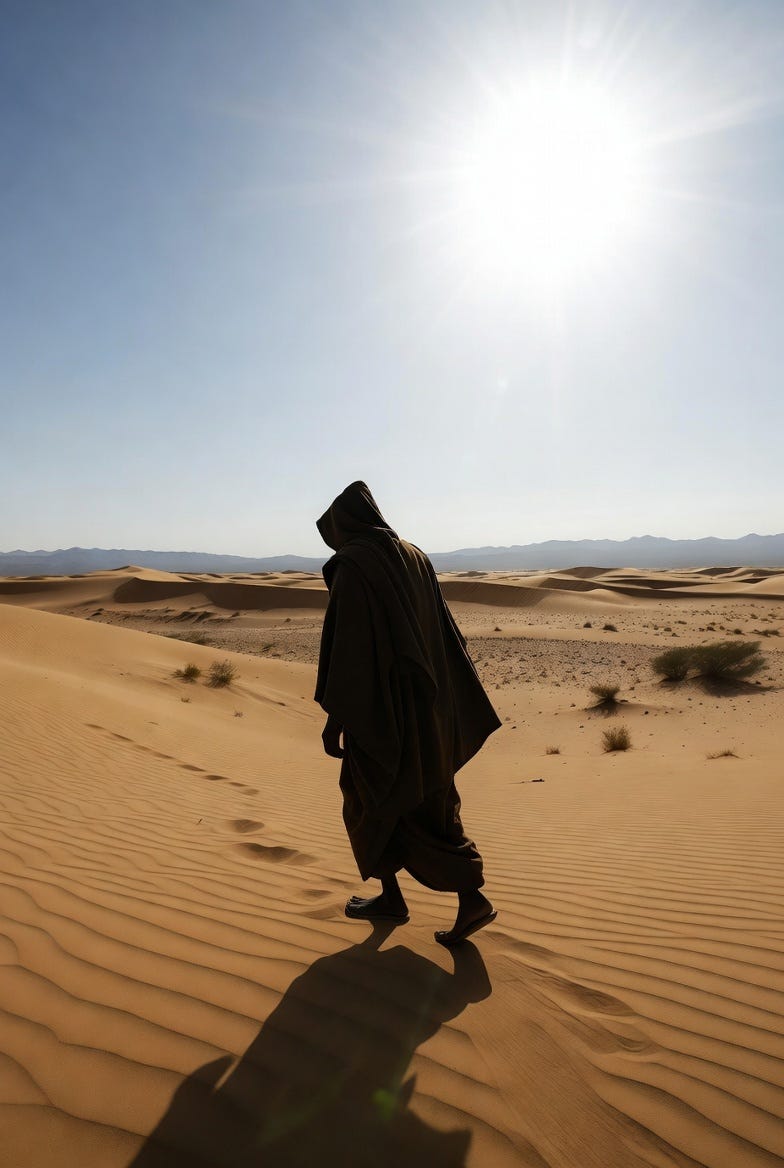
The Silence Before the Voice: John’s Years in the Desert
Picture for a moment the vast, unforgiving expanse of the Judean wilderness. The sun beats down without mercy upon ochre rock and sparse scrub. Wind whispers through canyons that have stood silent for millennia. No crowds gather here. No temple bells ring. No expectant faces turn toward a rising prophet. Only the relentless rhythm of day and night, heat and cold, hunger and thirst. Into this desolation stepped a man born under the most extraordinary circumstances—a child whose arrival had been announced by an angel, whose father had been struck mute until the name “John” was spoken, whose very existence fulfilled ancient prophecy. Yet for roughly thirty years after his miraculous birth, the biblical record offers nothing but silence.
I do not think this silence is an oversight in the narrative. It is the narrative’s most profound revelation. Between the heavenly announcement in the temple and the thunderous cry at the Jordan River, there stretches a hidden season: thirty years of obscurity, of unseen preparation, of a life deliberately withdrawn into the desert. No recorded miracles. No preserved sermons. No gathering crowds. Just the wilderness—raw, unyielding, and, in the economy of God, utterly essential.
In this article we sit with the uncomfortable question the preceding reflections have circled but never fully named: What transpired in those thirty years of silence, and why does Scripture preserve them as a deliberate void rather than a mere gap? The answer, I submit, lies at the heart of every authentic call to prophetic service. The wilderness was not the waiting room before John’s ministry began. It was the ministry’s foundation being laid, its anvil upon which a voice of unprecedented clarity was forged. To understand John the Baptist is to understand that the desert seasons of our own lives are not interruptions but divine laboratories of transformation. And to grasp this truth is to stand in awe before the meticulous, often hidden craftsmanship of God. A person with a truly prophetic voice must be content to live in the desert.
Consider first the world John deliberately left behind. He was born into the honored lineage of the Levitical priesthood. His father, Zacharias, belonged to the division of Abijah and served in the temple according to the sacred rotation (Luke 1:5, 8). Tradition and divine appointment had prepared for John a future of recognized status, communal respect, and structured religious duty. The priesthood offered security, influence, and the daily rhythms of sacred service that defined Jewish life under the law. To forsake this inheritance was no small decision. It meant stepping away from the prestige that accompanied temple service, from the social fabric that sustained family and community, and from the predictable path of respectability that most would have embraced without question. John was the one and only son of Zacharias and Elisabeth, the only chance they had to continue their family name. What must they have felt seeing John walk away from his inheritance and to embrace the desert?
John walked away not in priestly garments but in rough robes that were more than a fashion statement; they were a visible declaration of severance. Where once the fine linen and embroidered garments of priestly office might have marked him as set apart for holy service, the camel-hair cloak aligned him instead with the prophets of old—Elijah chief among them—whose lives were marked by austerity and singular devotion. Yet beneath the symbolic clothing lay a deeper, more costly reality: the emotional and relational price of such a departure.
What did it cost John, in the quiet recesses of his soul, to walk away from the expectations of his family and community? One can only imagine the conversations that never happened—the disappointed glances, the questions left unanswered, the subtle (or not-so-subtle) pressure to return to the familiar path. To choose the desert meant embracing loneliness in place of belonging, simplicity in place of provision, and the silence of solitude in place of the affirming conversations of the city. It meant bearing the weight of being misunderstood by those who loved him most. For many who read these words today, the parallel strikes with uncomfortable precision. What established patterns, respected roles, or comfortable futures must we relinquish in order to heed the same call? The cost is rarely announced with trumpets; it arrives in the steady erosion of human applause, often in the absence of familiar affirmation, and in the daily discipline of obedience when no audience watches.
Yet Scripture reveals that God has consistently employed the wilderness as His preferred classroom for those He intends to use in public service. This is no coincidence; it is a divine pattern woven through the pages of redemption history, evoking a profound sense of awe at the consistency of the Creator’s methods. Consider Moses. After forty years of privilege in Pharaoh’s court—educated, powerful, and positioned for influence—he fled to Midian, where he spent another forty years tending sheep in the wilderness. The impulsive prince who once attempted to deliver a fellow Israeli from a beating, needed to learn humility, patience, and utter dependence upon God amid the silent hills. Only then was he ready to stand before Pharaoh and declare, “Let my people go.”
The same refining fire appears in the life of Elijah. Fleeing the wrath of Jezebel, he journeyed to Horeb, the mountain of God. There, amid wind, earthquake, and fire, the prophet discovered that the voice of the Lord was not in the spectacular displays but in the still, small whisper (1 Kings 19:11-12). The wilderness stripped away every illusion of self-reliance and recalibrated his calling with surgical precision. Likewise, the children of Israel, having been delivered from Egypt through signs and wonders, were led into the wilderness for forty years. What appeared as aimless wandering was in reality a divine curriculum in dependence. Manna from heaven, water from rock, the pillar of cloud by day and fire by night—every provision taught them that their sustenance came not from their own strength but from the hand of the faithful Provider. The desert dismantled their Egyptian mindset and prepared them, however imperfectly, to enter the Promised Land as a people set apart.
Even our Lord and Savior Jesus Himself submitted to this pattern. Immediately after His baptism, the Spirit led Him into the wilderness (Matthew 4:1). After forty days of fasting—His body emaciated, strength utterly depleted, and every human faculty stretched to the breaking point—the tempter approached precisely when the Son of God may have stood at His weakest. The devil offered no novel scheme; he deployed the same ancient playbook he had used in Eden and would employ against every soul since: an assault upon the desires of the flesh. “If You are the Son of God, command that these stones become bread” (Matthew 4:3). In that moment of profound physical exhaustion, the temptation struck not at strength but at vulnerability—the raw, insistent cry of the body for immediate relief. Scripture reveals that the adversary has not revised his tactics; he repeats this identical strategy today with relentless precision. Just as you near the threshold of conquering your own flesh—when the fast has nearly broken the grip of the flesh, when the disciplines of silence and restraint have begun to loosen the chains of distraction, when victory over lesser desires seems finally within reach—that is the precise hour the devil intensifies his assault. He waits for the moment of deepest fatigue, when the spirit is willing but the flesh feels crushed beyond endurance, and then whispers the lie that one small concession would bring relief. Here the lesson burns with solemn awe: even when we are broken and tired beyond measure, we must hold fast until the last. Jesus did not yield; He answered with the living Word, refusing to shortcut the Father’s will. In doing so, He models for every believer that the wilderness does not end at the first sign of victory but demands perseverance through the fiercest final onslaught. The same sustaining grace that carried the Son through His weakest hour stands ready for us, forging in our exhaustion a resolve that no temptation can ultimately overcome. In each of these accounts, one witnesses the same awe-inspiring reality: the desert does not merely test; it transforms. It strips away noise, dismantles false identity, and severs dependence upon human approval. What remains is a voice no longer shaped by the crowd’s desires but by the clear command of God.
John the Baptist emerged from his years in the wilderness bearing the unmistakable imprint of this divine process. He did not leave the desert softened by comfort or compromised by consensus. He left sharpened to a single, unwavering point. His message rang out with prophetic authority precisely because it had been forged in isolation: “Repent, for the kingdom of heaven is at hand” (Matthew 3:2). The crowds that eventually flocked to the Jordan did not hear the polished oratory of a temple-trained priest. They encountered a man whose words carried the weight of years of unseen obedience. The wilderness had produced clarity where the world offers confusion, conviction where the age peddles compromise, and courage where fear would have silenced lesser voices.
This truth finds direct and practical expression in the journey outlined in the earlier article “Leveling Up the Leader Inside of You.” The disciplines commended there—fasting, dietary restraint, disciplined study of Scripture, and the intentional cutting off of substances and distractions—are not peripheral suggestions for improved health or optional exercises in self-improvement. They constitute the contemporary believer’s deliberate entry into a personal wilderness season. They are not a literal relocation to the Judean desert, yet they accomplish the same spiritual work: a systematic withdrawal from the relentless noise of the present age in order to hear the voice that is truly worth proclaiming.
Consider the power of fasting. In a culture saturated with instant gratification, the decision to abstain from the needs, wants, and desires of the flesh, for a season is an act of holy defiance. It declares that our deepest hungers will not be satisfied by bread alone but by every word that proceeds from the mouth of God. Dietary discipline—choosing simplicity over excess, restraint over indulgence—mirrors John’s own locusts-and-wild-honey existence. It trains the appetites to submit rather than rule. The systematic study of Scripture, pursued not for information but for transformation, saturates the mind with eternal truth until it displaces the fleeting narratives of the world. And the deliberate removal of substances and digital distractions creates space—precious, protected space—where the still, small voice of God can once again be discerned.
These practices are not ends in themselves. They are the modern reader’s pathway into the same refining fire that shaped John. When schedules are reordered to prioritize solitude with God, when screens are silenced and the mind is renewed by the Word, when appetites are brought under submission and the heart is weaned from the approval of others, the wilderness does its sacred work. Layer by layer, false identities are peeled away. Dependence upon human applause is severed. A voice begins to form—not the echo of cultural trends, but the authentic utterance of one who has heard from heaven.
One cannot reflect upon these matters without a deepening sense of awe. The God who spoke galaxies into existence chooses the barren places—the silent deserts, the hidden years—to prepare vessels for His glory. He does not rush the process. Thirty years for John. Forty years for Moses. Forty days for the Son of God. In a world obsessed with speed and visibility, this divine pace invites us to reconsider our own impatience. The silence is not emptiness; it is pregnant with purpose. The wilderness is not wasteland; it is workshop. The disciplines are not drudgery; they are the hidden architecture upon which eternal legacies are built.
John did not leave the desert softened. He left sharpened. The world to which he returned offered him no reward of acclaim or safety. It eventually demanded his head. Yet before that final cost was exacted, his voice had already fulfilled its singular, eternal purpose: it prepared the way for the One who was greater. In the same manner, the wilderness seasons we are invited to embrace are not ends in themselves. They are the hidden foundation upon which a voice capable of preparing the way is forged.
The uncomfortable question now stands before us without evasion: Are we willing to embrace the however many years of silence are necessary—the daily, unseen disciplines of the desert—so that when the moment arrives, our voice will be ready? The desert awaits. The foundation is being laid even now. The choice, as it was for John, remains ours.
Yet let us linger a moment longer in awe before the magnitude of what God accomplishes in such hidden places. The same Creator who orchestrated the precise timing of John’s birth—six months before the Messiah’s—also ordained the precise duration of his preparation. Nothing was wasted. The years of silence were as integral to the divine plan as the dramatic day when the heavens opened and the Spirit descended like a dove. In that moment, all the hidden forging bore visible fruit. The voice that had been tempered in solitude thundered across the Jordan Valley, calling multitudes to repentance and pointing unerringly to the Lamb of God.
“John answered, saying unto them all, I indeed baptize you with water; but one mightier than I cometh, the latchet of whose shoes I am not worthy to unloose: he shall baptize you with the Holy Ghost and with fire:” Luke 3:16
We stand today at a similar threshold. The age in which we live is marked by unprecedented noise—digital clamor, political division, cultural upheaval. Never has the need been greater for voices that have been refined in the wilderness rather than shaped by the marketplace. The disciplines of fasting, Scripture saturation, and holy restraint are not relics of a bygone era; they are the timely instruments by which God continues to prepare a people for such a time as this. As we yield to them, we join the long line of those who have discovered that the desert is not God’s abandonment but His appointment.
Consider, what your own wilderness season might look like in the days ahead. It may not involve camel’s hair or locusts, but it will surely involve the same essential surrender: the willingness to step away from the familiar comforts, the recognized roles, and the affirming applause in order to stand alone and naked before God. The emotional cost may feel steep at first. The relational questions may linger. Yet the reward is a clarity and authority that no human credential can bestow.
To step into the desert as John did is to embrace a pain few are willing to name aloud. It is the quiet, persistent ache of watching familiar faces recede in the distance—conversations among lifelong friends that no longer include your voice, and the subtle shift in their eyes from admiration to bewilderment, or worse, to pity. John, born into the warmth of priestly lineage and community expectation, would have felt this severance acutely. The same relatives who once celebrated his miraculous birth now whispered concerns about the son of Zacharias wandering among jackals and scorpions instead of standing in the temple courts. The friends of his youth, bound to the rhythms of village life, marriage, and ordinary vocation, would not follow him into that barren expanse. There would be birthdays unmarked, feasts unattended, and the slow erosion of shared memories as the desert claimed more of his days. This was no romantic adventure; it was relational crucifixion—the daily dying to the comfort of belonging, the sting of being labeled eccentric or even rebellious by those who loved him most. Yet in this very pain lies a sacred threshold. For it is only when we have counted the cost and still chosen the wilderness that we discover the deeper fellowship awaiting us there: not the shallow affirmation of men, but the intimate, sustaining presence of the God who calls us out.
“And Jesus answered and said, Verily I say unto you, There is no man that hath left house, or brethren, or sisters, or father, or mother, or wife, or children, or lands, for my sake, and the gospel’s, But he shall receive an hundredfold now in this time, houses, and brethren, and sisters, and mothers, and children, and lands, with persecutions; and in the world to come eternal life.” Mark 10:29-30
Perhaps you may feel an ache rising even now as you are contemplating the conversations that will grow awkward, the invitations that will cease, or the quiet disapproval of those closest—take heart. The same God who sustained John in his isolation stands ready to meet you in yours. The pain of departure is real, but it is never the final word. It is the doorway through which a voice refined by solitude eventually emerges to shake the world.
In the articles that have preceded this one—reflections on the Exodus archetype, the Elijah effect, the turning of hearts, and the leader within—we have traced the consistent pattern of God’s dealings with His people. Time and again, He leads us into places of apparent desolation in order to reveal His sufficiency. The silence before the voice is never the end of the story. It is the necessary prelude to a proclamation that shakes nations and prepares the way for the King.
May we, like John, embrace the desert with open hands and expectant hearts. May we allow the wilderness to do its refining work until our voices, tempered by silence and sharpened by obedience, rise with the singular cry that matters above all others: “Prepare the way of the Lord.” The foundation is being laid. The moment approaches. The choice is ours.
What, then, should we be doing? The answer lies not in frantic activity but in faithful withdrawal. Enter the silence. Embrace the disciplines. Yield to the desert. For in that hidden place, God is forging something eternal—something that will one day thunder across the Jordan of our own generation, pointing unerringly to the Lamb who takes away the sin of the world.
Thanks for stopping by again and sharing your time with me.
Signing off till next time.
Silver