

Giving with Purpose
Tithing, Offerings, & Alms

The Tripartite Structure
As we examine the structure of the Tabernacle, we see it is composed of three distinct parts: the outer court, the Holy Place, and the Holy of Holies. In the same way, the structure of our giving should reflects this divine pattern. Each part has its own vital purpose, and all of it matters—tithes, offerings, and alms. Far from being separate practices, they form a unified, progressive journey into the very presence of God, just as the Israelite worshipper moved step by step from the dusty wilderness ground toward the glory veiled in the innermost sanctuary.
Too often when people ask, “What should I give to God? What exactly is tithing?” what they are really asking is something far more revealing: “What am I obligated or expected to give? What is the absolute minimum I can get away with and still be considered a ‘good’ person?”
To this question, God has given a clear answer that should cut straight to the heart:
“Let every man give as he purposeth in his heart… not grudgingly, or of necessity: for God loveth a cheerful giver” (2 Corinthians 9:7).
The Tabernacle was never meant to be a burden laid upon a weary people. It was meant to be a source of joy, a portable sanctuary built in the wilderness that invited Israel—and invites us today—to experience the nearness of God amid uncertainty, scarcity, and transition. Understanding this changes everything. When we truly grasp the why behind our giving, the how—whether to a struggling neighbor, a small group of believers, a local assembly, or a broader work of restoration—begins to shine with clarity. And then the what—whether money, time, clothing, food, skilled labor, or heartfelt prayer—becomes not a duty but a natural, joyful overflow.
3 Nephi 11:2-3 records that after His resurrection, Jesus commanded the Nephites to record and then he would personally expounded the words of the prophet Malachi. These were not words spoken to outsiders or unbelievers, but to God’s own covenant people. They had traveled to the temple, offered sacrifices, prayed, and fasted with outward regularity. Yet the Lord declared something was missing, in some meaningful way they had strayed from His ordinances. Their traditions had become hollow. Their hearts had lost the living purpose. They had become like robots, mechanically performing the motions while missing the heart of the matter. Because they had lost the why, the how and the what had grown into heavy, joyless burdens. Jesus called out his people for saying, “…it is vain to serve God: and what profit is it the we have kept his ordinance,…” Malachi 3:14
The Lord’s invitation to them—and to us—is first to examine our hearts and then to return to renewal:
“Bring ye all the tithes into the storehouse, that there may be meat in mine house, and prove me now herewith, saith the Lord of hosts, if I will not open you the windows of heaven, and pour you out a blessing, that there shall not be room enough to receive it.” (Malachi 3:10; see also 3 Nephi 11:13)
He further promises that those who return with sincere hearts will once again “discern between the righteous and the wicked, between him that serveth God and him that serveth him not” (Malachi 3:18; see 3 Nephi 11:21).
This is one of the most remarkable and practical promises in all of scripture. When we return to the Lord through wholehearted, cheerful giving—tithes, offerings, and alms offered not grudgingly but with sincere hearts—something profound shifts within us. We regain the ability to clearly see and distinguish truth from deception, light from darkness, and genuine service to God from empty religious performance.
Why does giving with all our hearts sharpen our spiritual discernment?
First, sincere giving purifies the heart. When we hold nothing back—when we move beyond calculating the minimum and instead offer our resources, time, and very lives as the widow did with her two mites—we dethrone self-interest. The outer court of personal sacrifice, the Holy Place of communal devotion, and the Holy of Holies of covenant faithfulness all work together to align our priorities with God’s. A heart that is fully surrendered to the Lord becomes a clean vessel, sensitive to the promptings of the Holy Spirit. Impure motives like pride, greed, or self-righteousness cloud our vision; generous, faith-filled giving washes them away, much like the priests washed at the bronze laver before entering God’s presence.
Second, wholehearted giving draws us into greater intimacy with God. The Tabernacle was built so that God could dwell in the midst of His people. When we faithfully bring our tithes into the storehouse, support His work, and care for His children, we are actively participating in that dwelling. The closer we draw to the mercy seat—through obedient, joyful giving—the clearer we hear His voice. Malachi’s promise is not abstract; it is experiential. Those who prove God with their substance (Malachi 3:10) are granted eyes to see what others miss: the difference between those who truly serve Him and those who merely go through the motions.
Third, this discernment is covenantal. In the days of Malachi and the Nephites, God’s people had lost their way because their hearts were divided. Their giving had become mechanical, their worship hollow. But when they returned with sincerity, the fog lifted. They could once again recognize true righteousness—not by outward appearances, but by the fruit of surrendered lives. Today, in our own wilderness journeys, the same principle holds. A generous heart attuned to God’s work becomes skilled at spotting the genuine move of the Spirit in a meeting, discerning true leadership from self-promotion, and identifying real needs that require alms, offerings, or tithes. It protects us from deception and empowers us to build up the kingdom rather than tear it down.
In a world filled with confusion, competing voices, and counterfeit spirituality, this promise is a lifeline. Those who give with all their hearts are not left guessing. They walk in clarity. They become spiritual watchmen, capable of distinguishing the righteous path from the broad way that leads to destruction. They gain the wisdom needed for restoration—for rebuilding families, communities, and ultimately contributing to the New Jerusalem.
Giving
Beyond the simple structure and outward purpose of giving lies something far deeper and more transformative. In the tripartite design of the Tabernacle we see the three “whys” of giving, perfectly coordinated with the three modes found in scripture: alms, offerings, and tithes. This sacred pattern trains us in spiritual discernment. It teaches us to move progressively from the visible compassion and sacrifice of the outer court, through the shared fellowship and nourishing light of the Holy Place, and into the holy center of covenant faithfulness in the Holy of Holies. Each layer builds upon the last, forming not a mere checklist of religious duty, but a living pathway that draws us—and those around us—ever closer to the glory of God’s presence.
As we explore more in-depth the tabernacle, we will walk this path together. We will explore how alms are reflected in the open, sacrificial outer court; how offerings sustain the illuminating life of the Holy Place; and how the three tithes anchor us in the very center of the Holy of Holies, where God’s law, provision, and mercy meet. Through this journey, may we rediscover the joy of cheerful giving and become a people among whom the Lord is pleased to dwell.
Giving: The How
Alms: Reflected in the Design of the Outer Court of the Tabernacle.
Alms, simply put, are the good deeds we do in fulfilling the second great commandment: “love your neighbor as yourself” (Matthew 22:39). This is what we do, often daily, as we see needs in the lives of those around us—family, friends, fellow believers, or complete strangers we meet along the way. The answer to those needs is seldom money. More often it is time: a listening ear, a helping hand, a word of encouragement, or practical assistance in someone’s wilderness season. Whatever the need, our response should always begin with prayer—asking God how He would have us help or meet the needs of this person. Don’t allow your alms to become mechanical, just throwing money at a problem to get it out of your hair.
This outward ministry of compassion is beautifully reflected in the outer court of the Tabernacle. Picture this large, open enclosure—roughly 150 feet long by 75 feet wide—surrounded by white linen curtains that formed a visible boundary between the inner court and the outer chaos of the world. Everyone, who was willing to make a simple effort could enter here. It was the threshold, the first place of encounter for a people learning to walk with God in the wilderness. Two primary bronze furnishings stood here: the altar of burnt offering and the laver for washing. There represented the voluntary cost to enter.
The bronze altar was the place of sacrifice. It was costly. Blood was shed and offerings consumed by fire. True alms carry this same spirit of sacrifice. When we give our time, attention, or resources to meet a neighbor’s need, we lay something on the altar. It may cost us comfort or plans, yet it flows from first offering ourselves to God as “a living sacrifice” (Romans 12:1). Our daily acts of kindness—praying with a struggling parent, sharing a meal with the lonely, or carrying another’s burden—are living expressions of this altar. Love for God naturally spills over into love for others.
Next stood the bronze laver, filled with water for washing before entering the Holy Place. Bronze, refined in fire, which speaks of judgment and purification. Here we learn that our good deeds must flow from a cleansed heart. Before rushing to “fix” someone else, we pause and pray: “Lord, search me. Wash away any pride or impure motive.” Only then does our help remain pure, reflecting God’s holiness rather than our own strength.
The white linen curtains remind us of the purity that should mark our lives as we engage the world. The open design shows this love is meant to be visible and accessible. For Israel in the wilderness—and for us today wherever our journey leads—every act of alms helps build God’s dwelling place among His people. Begin at the altar with surrender. Pause at the laver with prayer. Then step forward in love. In doing so, we bring heaven’s reality into the ordinary moments of life.
This is the starting point of the journey inward.
Offerings: Reflected in the Design of the Holies.
Offerings, where physical and spiritual blend, are the gifts we give in our local community and church to meet needs we cannot resolve alone—building and maintaining a meeting hall, covering ongoing costs so that the gospel can be taught and God’s people can come together in worship and praise. Also allowing us to step up when problems are too great for one or two people. When a member loses everything in a fire or faces prolonged illness and lost work, the community comes together to do what typically no individual could do alone.
This corporate ministry finds its reflection in the inner chambers of the Tabernacle—the Holy Place. After passing through the outer court, we move deeper. The Tabernacle itself was built through the willing offerings of the entire community (Exodus 35:4-29). Our offerings sustain that shared spiritual dwelling place today.
In the Holy Place stood the golden menorah, its seven branches burning continuously with pure oil, bringing light into darkness, the continuous light of God ever lighting our way. Our offerings keep the lights on—funding teaching, Scripture distribution, and ministries that give direction to the body of Christ. It witness to the continual revelation of God to His people, through prophecy, dreams, and visions: “…precept upon precept, precept upon precept; line upon line, line upon line; here a little, and there a little;…” (Isaiah 28:13). The table of showbread held twelve loaves, representing shared sustenance and fellowship for all Israel. Our offerings reflect this when the gospel is available and taught for all who wish to come, when we rebuild homes, provide meals, or maintain a welcoming table where saints strengthen one another. At the far end rose the altar of incense, its fragrant smoke ascending as the prayers of the saints (Revelation 8:3-4). “But behold I say unto you, that ye must pray always, and not faint:…” (2 Nephi 14:12) Our constant prayers—for the needs of those around us, for the sick and afflicted, for the gospel work, for the unbelievers—are a pleasing aroma before the Lord.
As we draw nearer to God’s presence, the materials shift from bronze to gold, calling for deeper devotion. Just as Bezalel and Oholiab were filled with the Spirit to craft these holy things, our communal giving invites the Spirit to build something eternal. Offerings turn individual faith into a testimony of unity, provision, and glory, preparing the way for the Lord’s presence to fill the house once more (Exodus 40:34-35).
Tithes: The 3 Tithes: Reflected in the Design of the Holy of Holies.
At the center stands the Holy of Holies—a perfect cube veiled in glory, the most sacred space where heaven touched earth. Here rested the Ark of the Covenant, overlaid inside and out with pure gold, containing three precious items that represent the very foundation for the continuation and flourishing of God’s people.
Inside the Ark were the tablets of the law—the unchanging word of God that governs His covenant people and establishes the divine framework for righteousness, justice, and holy living. These tablets reminded Israel (and remind us) that true freedom is found not in lawlessness but in alignment with the will of a loving Father.
Also preserved within the Ark was a jar of manna—the miraculous bread that fell from heaven every morning during the wilderness journey. This was God’s provision and a symbol of continual revelation: the living word that sustains His people day by day. Just as the Israelites could not store manna for tomorrow without it spoiling (except on the Sabbath), this jar testified that God’s people must rely daily on fresh manna from above—fresh revelation, fresh guidance, and fresh strength from the Lord.
Finally, there was Aaron’s budding rod—the dry stick that miraculously blossomed and produced almonds, confirming God’s chosen authority. It stands as a powerful witness that spiritual authority and priesthood cannot be assumed, seized, or granted by men. It belongs only to those upon whom God Himself bestows it. This rod was a perpetual reminder against rebellion and presumption, declaring that leadership in God’s house must be divinely appointed and Spirit-led.
Above the Ark, between the outstretched wings of the golden cherubim on the mercy seat, the glory of God would descend and speak with His people (Exodus 25:22). Only the high priest could enter this awe-inspiring place once a year, and only with blood of atonement.
These three sacred items—the law, the manna, and the rod—were not relics of the past. They are the essential pillars that sustain any people who desire God to dwell among them. In the same way, our faithful tithes help preserve and uphold these realities today: the preaching and living of God’s law, the continual flow of revelation and provision, and the honoring of divinely appointed authority. Without them, the center cannot hold, and the glory departs. With them, maintained through cheerful and obedient giving, the Lord is pleased to dwell in the midst of His people.
The First Tithe (Numbers 18:21-24) supported the Tabernacle itself—its maintenance, implements, and the service of the Levites and priests who had no land inheritance because “the Lord is their inheritance.” Malachi simply called it providing “meat in mine house” (Malachi 3:10). This tithe corresponds to the Ark itself—the costly center where God’s presence rested. Today it upholds core church work: meeting places, full-time ministry, sacred writings, translations, and worship tools. Without it, the center cannot hold.
The Second Tithe (Deuteronomy 14:22-27) funded the feasts, especially the Feast of Tabernacles, so God’s people could gather, rejoice, eat before the Lord, and learn to fear Him. It resonates with the joyful, sustaining communion of the Holy Place and Holy of Holies. Today it supports gatherings, conferences, and shared celebrations that strengthen bonds across distances and turn personal blessings into corporate joy.
The Third Tithe (Deuteronomy 14:28-29), gathered every third year, cared for widows, orphans, Levites, and the poor—addressing needs too large for alms or regular offerings. It flows from the mercy seat, extending the inner sanctuary’s atonement and grace to the vulnerable edges of the community.
No one was absolved from giving, even the Levites tithed (Hebrews 7:5, 9), showing that all participate in the cycle of giving. In the Holy of Holies, the high priest himself needed mercy.
In the Holy of Holies we see the unifying purpose of all three tithes: they sustain the place where God’s law is honored, His provision remembered, and His mercy extended. Faithful tithing invites the glory of the Lord into our midst.
From the outer court of alms, through the Holy Place of offerings, to the Holy of Holies of tithes, every gift becomes part of building an eternal sanctuary—a people prepared for the New Jerusalem, where God Himself will be the Temple. With this structure, God has given us all we need to serve Him with all our might, mind, and strength, and to love our neighbor as ourselves. In this way, the building of the New Jerusalem and the restoration of His work moves forward.
The Widow’s Two Mites: The Ultimate Example
As we stand considering the structure of the Tabernacle—moving from the open sacrifice of the outer court, through the shared light and fellowship of the Holy Place, and into the covenant center of the Holy of Holies—we are confronted with one final, piercing question: How far should we truly be willing to go?
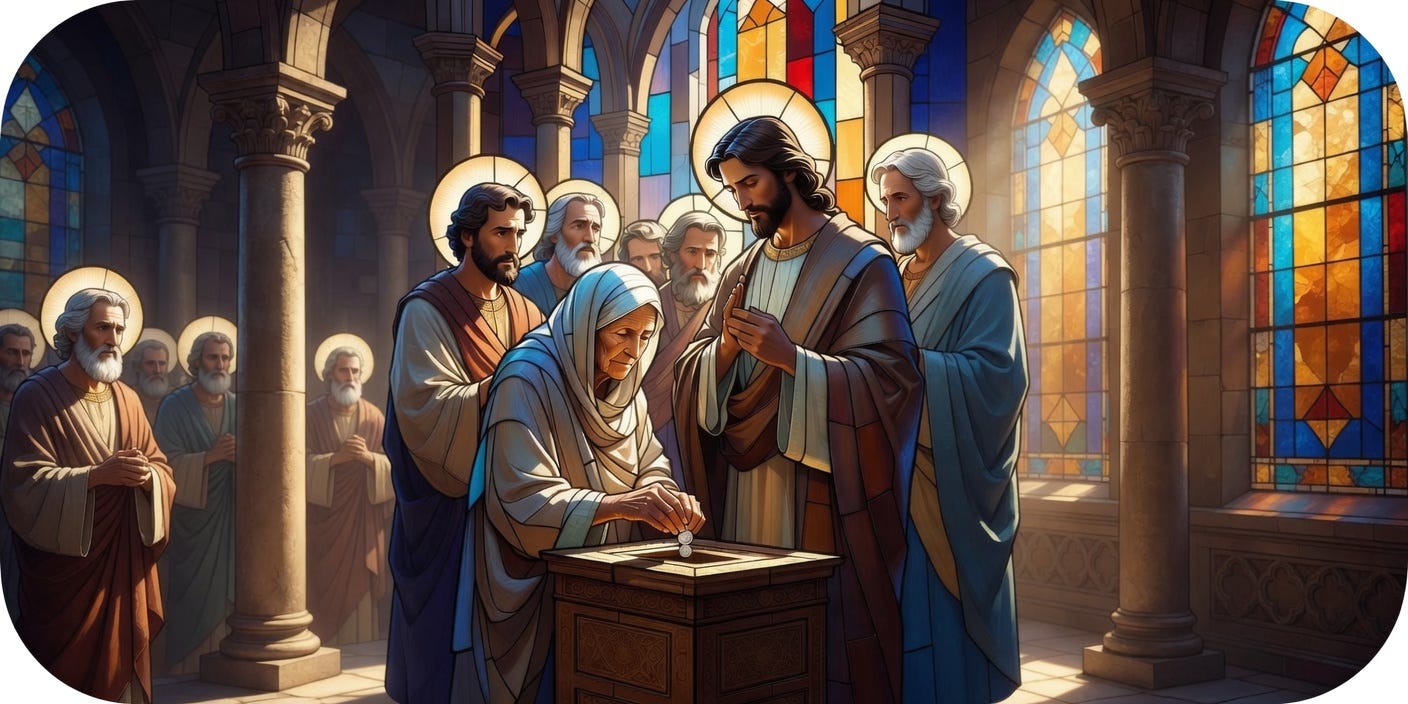
The Lord Himself gives us the answer in the story of a poor widow who quietly approached the temple treasury one day. While the rich cast in large sums from their abundance, this humble widow dropped in two small copper coins—mites—the very last she possessed for her own daily bread. In the eyes of the world, her gift seemed utterly insignificant.
But Jesus saw it! With holy excitement and wonder filling His heart, the Lord called His disciples over to behold this extraordinary sight. “Come and see!” His words must have carried, drawing their attention away from the grand displays of the wealthy. He declared with divine admiration that she had given more than all the others combined, because “they all gave out of their abundance, but she out of her poverty has put in everything she had, all she had to live on” (Luke 21:4).
What a powerful, breathtaking moment! The Savior of the world, who sees and judges every heart, was moved with joy and pointed her out as the greatest giver of that day. Her two tiny mites were not overlooked or despised—on the contrary they shone like stars in the treasury of heaven.
This widow did not calculate the minimum. She did not give grudgingly or out of obligation. She gave from a heart that had already passed through the outer court of personal sacrifice and the Holy Place of communal trust, and had come to rest in the very center of the Holy of Holies—complete surrender to the faithfulness of God. Her two mites were not merely money; they were an act of profound faith and trust in God’s promises. She was willing to entrust her very sustenance, her today, and her life itself into the hands of the One who had said, “Prove me now herewith… if I will not open you the windows of heaven, and pour you out a blessing” (Malachi 3:10).
In her quiet act, the widow becomes the living witness and fulfillment of everything the Tabernacle was meant to teach us. She understood that nothing—absolutely nothing—is more important than the work of God. Not her comfort. Not her security. Not her retirement. Not even her next meal. She gave all she had because she believed the work of the Lord was worth everything. Her gift was not the size of the offering; it was the size of her faith.
This is the example set before us. The same Lord who invited Israel to build the Tabernacle in the wilderness now invites us to build His kingdom in our own day. He is not asking for leftovers or convenient portions. He is asking for hearts that are willing, like the widow, to give all—even our plans, our comfort, our resources, and ultimately our very lives. For when we truly grasp the why behind the Tabernacle’s pattern, we discover that cheerful, sacrificial giving is not a burden. It is the pathway into the presence of God Himself.
May we, like that widow, move through the outer court of daily compassion, through the Holy Place of shared ministry, and into the Holy of Holies of total covenant trust—until our lives become living offerings, and the glory of the Lord once again fills His house. For the work of God is worthy of everything we have to give.
And in giving all, we will find that we have gained everything that truly matters.
Thanks for stopping by again and sharing your time with me.
Signing off till next time.
Silver