

Ascent to Power
Joseph of Egypt as a BluePrint

In the waning shadows of colonial dominion, on September 15, 1821, a profound cry for liberty echoed across the ancient lands of the remnant of Joseph. For just over two centuries, the vast territory known as the Captaincy General of Guatemala—encompassing the provinces of Guatemala, El Salvador, Honduras, Nicaragua, and Costa Rica—had labored under Spanish imperial rule. The Kingdom of Guatemala, as it was also called, had endured economic strain from the decline of indigo exports, repeated locust plagues, burdensome taxes, and the disruptive effects of the Napoleonic Wars that weakened Spain’s hold on its overseas possessions. The Peninsular War, the removal of Ferdinand VII from the throne, and the liberal Cádiz Constitution of 1812 had stirred political awareness and aspirations for greater autonomy among the Creole elites and broader population.
Earlier revolts in El Salvador (1811) and Nicaragua had been suppressed, yet the spirit of independence continued to smolder. When news reached Guatemala City of Mexico’s successful break from Spain under Agustín de Iturbide, the Provincial Council, presided over by the last Spanish Captain General Gabino Gaínza, convened in solemn session. Honduran statesman and intellectual José Cecilio del Valle drafted the historic Act of Independence of Central America. Without the thunder of battlefield cannons or rivers of blood, these peoples—descendants of Lehi and Mulek—cast off centuries of foreign yoke and declared themselves sovereign. The Act invited the provinces to send representatives to a congress that would determine their future governance, leaving open the possibility of union with Mexico or full independence.
A brief and often turbulent period of annexation to Iturbide’s Mexican Empire followed (1821–1823), marked by internal divisions, resistance (especially from El Salvador), and military interventions. When Iturbide’s short-lived empire collapsed in 1823, Central America seized its moment. On July 1, 1823, a liberal-dominated National Constituent Assembly in Guatemala City proclaimed absolute independence and established the Federal Republic of Central America (also known as the United Provinces of Central America). A forward-looking constitution, adopted in 1824, reflected liberal ideals inspired by the Cádiz Constitution and the United States model. Though the federation faced persistent strife between liberal and conservative factions, economic challenges, and regional rivalries, this visionary experiment in unity stood as a decisive lifting of the remnant from prolonged bondage. The federation eventually dissolved between 1838 and 1841 amid civil conflict, giving rise to the sovereign nations we recognize today. Yet the 1821 declaration and the brief federal republic represented a pivotal turning point in the divine timetable—breaking the chains of colonial subjugation and preparing the soil for a greater spiritual awakening among the covenant people.
This emancipation was no mere political event. It opened the door for the fulfillment of the Savior’s own words spoken to the Nephite people during His glorious ministry among them. In 3 Nephi 9:90 the Lord declared that His people would “be set up as a free people,” and in verse 93 He promised “that thy seed shall begin to know these things.” (Church of Christ [Temple Lot] edition) The rise of independent nations in Central America prepared the way for the remnant to receive the restored gospel, to come to a knowledge of their forefathers, and to recognize their Redeemer. Thus the divine work of gathering and restoration advanced according to the eternal plan.
The narrative of Joseph’s ascent from the depths of imprisonment to the pinnacle of authority in Egypt stands as one of the most compelling blueprints. It exemplifies a divine pattern of exaltation following humiliation, of preservation emerging from apparent destruction. Just as years of bondage and betrayal prepared Joseph to preserve life—not only for his own household but for the entire house of Israel—so the long night of trial endured by the remnant of Joseph precedes their latter-day restoration and their appointed role in building the New Jerusalem upon this land of promise.
Joseph in the Prison House: Faithfulness in Obscurity
The scriptural record bears witness to Joseph’s unwavering integrity amid crushing adversity. Sold by his brethren, falsely accused by Potiphar’s wife, and cast into the king’s prison, Joseph refused to allow bitterness to take root. Instead, we read these remarkable words: “And his master saw that the LORD was with him, and that the LORD made all that he did to prosper in his hand” (Genesis 39:3, KJV). Even in the dungeon, the favor of heaven rested upon him. The keeper of the prison soon committed all the prisoners into Joseph’s hand, for “the LORD was with him, and that which he did, the LORD made it to prosper” (Genesis 39:23, KJV).
It was in this unlikely setting that two of Pharaoh’s officers—the chief butler and the chief baker—found themselves imprisoned, each troubled by a dream. Joseph, ever quick to give glory to God, inquired of their sorrow and declared, “Do not interpretations belong to God? tell me them, I pray you” (Genesis 40:8, KJV). With divine precision he unfolded the meaning of each vision.
To the butler he spoke hope: “The three branches are three days. Yet within three days shall Pharaoh lift up thine head, and restore thee unto thy place” (Genesis 40:12-13, KJV). The budding vine and the cup placed in Pharaoh’s hand pointed to restoration and renewed service. To the baker, however, the message was solemn: “The three baskets are three days. Yet within three days shall Pharaoh lift up thy head from off thee, and shall hang thee on a tree” (Genesis 40:18-19, KJV). Both interpretations came to pass exactly as foretold. Yet the butler, restored to favor, “did not remember Joseph, but forgat him” (Genesis 40:23, KJV).
Here the stage was set for greater things, and a very real warning of danger.
Typological Significance of the Dreams
The butler’s dream, with its three branches bursting into life and bearing fruit that brought salvation to Pharaoh’s cup, carries profound latter-day implications. These three branches point to three vital restorations associated with the house of Joseph.
Leadership and National Restoration The budding leadership corresponds to the rising up and independence of the Central American nations beginning in 1821. This represents the rebirth of Joseph’s people—particularly the remnant of Manasseh in the lands of the Book of Mormon. Emerging from centuries of colonial bondage into a new era of self-determination, they stepped onto the stage of history as a free people, prepared for the covenant restoration that would soon follow. This was no coincidence, but part of the divine blueprint.
Priesthood and Authority The second branch speaks of the restoration of divine authority. In 1830 the true church was organized once more upon the earth, renewing priesthood keys and enabling the gathering of Israel and the preaching of the fulness of the gospel.
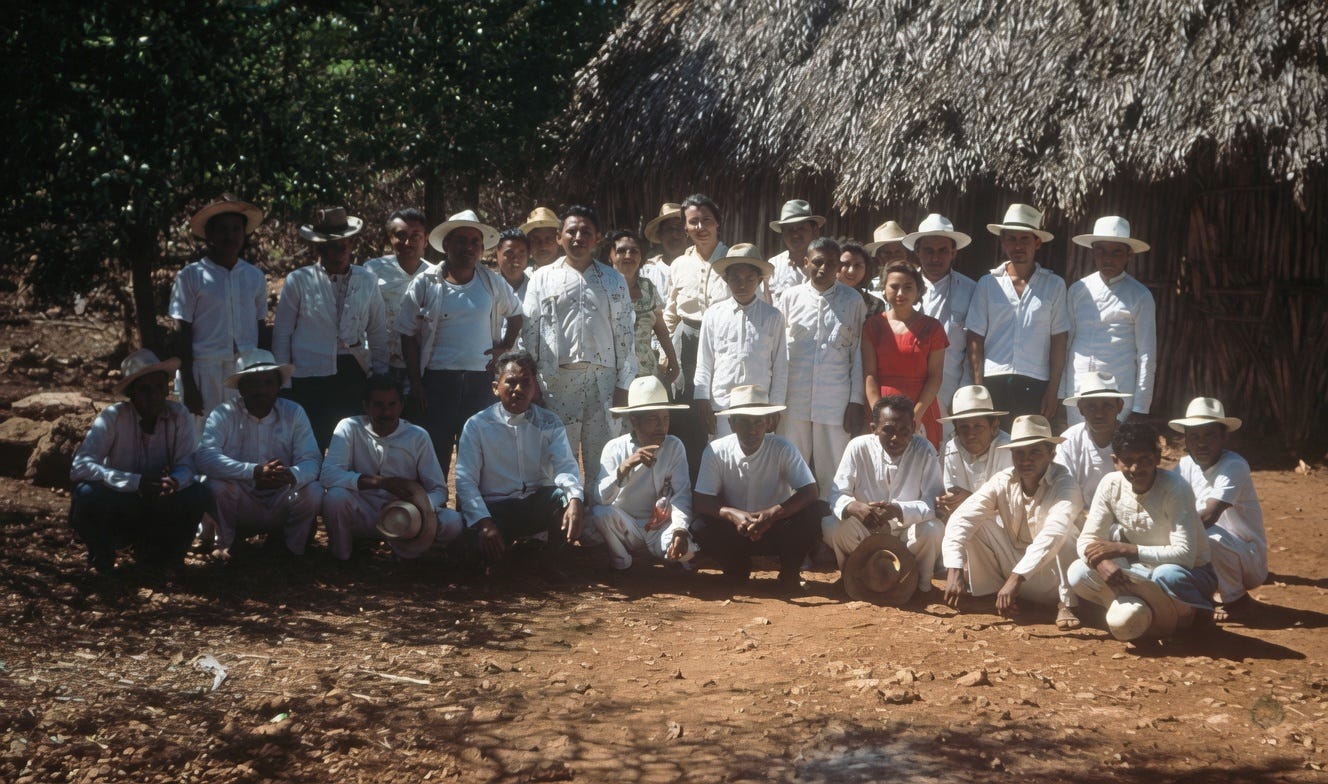
This restoration of authority extended in a most remarkable manner to the remnant of Joseph. In 1953, Apostle Clarence L. Wheaton met with the last of the Caciques of the Maya in the humble home of Nemensio Xiu in Ticul, Yucatan. (see also The Last Maya King and the Liberation of Jerusalem by Apostle Donald McIndoo) There, standing with Lorenzo Ek and Nemensio Xiu, the history of that portion of the family of Manasseh—broken off from the original tree—was received and brought back. Nemensio Xiu testified plainly to his people that the Book of Mormon was their story. His son Dionicio had earlier received a dream that two white people would come bringing the gospel to the house of his father. The following year the church was organized among them, and once again true callings for ministry were extended, with the authority of God returning in power to the house of Joseph.
Double Portion Inheritance The third branch points to the double portion inheritance given to Ephraim and Manasseh (Genesis 48). Ephraim has been linked to the great latter-day work centered in the United States, while Manasseh finds its covenant home among the remnant in Central America and Mesoamerica—the very lands of the Book of Mormon.
This double portion includes the glorious outpouring of the Spirit prophesied by Joel and quoted by Peter: “And it shall come to pass in the last days, saith God, I will pour out of my Spirit upon all flesh: and your sons and your daughters shall prophesy, and your young men shall see visions, and your old men shall dream dreams: And on my servants and on my handmaidens I will pour out in those days of my Spirit; and they shall prophesy” (Acts 2:17-18, KJV; Joel 2:28-29). In an age of spiritual famine and widespread confusion, there is a pressing need for true spiritual guides—visionary leaders, prophets, priests, and teachers patterned after Joseph of Egypt. These are individuals who walk in close communion with God, who can interpret the signs of the times, and who will lead God’s people through the latter-day wastelands toward Zion and the New Jerusalem.
The Warning of the Baker’s Dream In stark contrast, the baker’s dream—with its three baskets of bakemeats devoured by birds—warns of corruption, false leaders, and false systems that cannot preserve life. The Savior’s solemn caution echoes down the corridors of time: “Beware of the leaven of the Pharisees and of the Sadducees” (Matthew 16:6, KJV). This leaven represents false leadership rooted in pride and position, counterfeit spirituality that intoxicates but does not nourish, and empty doctrines that promise much but deliver no true sustenance. In our day we witness the increasing exposure of misinformation, spiritual deception, and hollow institutions. The baker’s fate stands as a sobering reminder that only that which is of God will endure.
Pharaoh’s Dreams and Joseph’s Astonishing Rise
Two full years passed. Then Pharaoh himself was troubled by two dreams: seven fat kine devoured by seven lean ones, and seven full ears of corn swallowed by seven thin ears blasted by the east wind (Genesis 41:1-7, KJV). All the magicians and wise men of Egypt were summoned, yet none could solve the puzzle. At last the chief butler remembered Joseph. His testimony was simple yet powerful: this Hebrew prisoner had interpreted dreams with perfect accuracy, foretelling both life and death.
Why would the mightiest ruler on earth listen to a foreign slave languishing in prison? Divine orchestration and credible eyewitness testimony provided the answer. Joseph not only interpreted the dreams but offered a wise and practical solution: appoint a discerning man to gather grain during the seven years of plenty against the seven years of famine. Pharaoh, moved by the Spirit, declared: “Forasmuch as God hath shewed thee all this, there is none so discreet and wise as thou art: Thou shalt be over my house, and according unto thy word shall all my people be ruled: only in the throne will I be greater than thou” (Genesis 41:39-40, KJV).
At thirty years of age, Joseph rose from prisoner to second in command over all Egypt. Pharaoh bestowed upon him the name Zaphnath-paaneah and gave him Asenath, daughter of Potipherah priest of On, to wife. The young Hebrew who had been betrayed, enslaved, and forgotten now stood as a representative of God to the unbelievers.
Egypt’s Prosperity and the Pattern for the Remnant
Under Joseph’s administration, Egypt became a beacon of sustenance while famine ravaged the surrounding lands. The Lord preserved the realm through His chosen servant, demonstrating how covenant people become a blessing to the nations among whom they dwell. In like manner, the remnant of Joseph—identified in latter-day scripture with the indigenous peoples of the Americas—endured centuries of bondage under Gentile powers. The 1821 independence movement served as a pivotal stage in their partial emancipation, divine preservation, and preparation for fulfilling God’s plans.
Latter-Day Parallels and the East Wind
Great empires of antiquity—Sumer and Akkad, Babylon and Assyria, the Hittites, Phoenicia, Carthage, Rome, and many others—rose in splendor only to crumble into dust. None proved perpetual. Why? They all fell to rebellion against the one true God and worldliness. Hosea prophesied that in the latter days, Ephraim, though fruitful among his brethren, would experience a diminished spiritual connection. The east wind of divine judgment would dry up his spring of inspiration. “Though he be fruitful among his brethren, an east wind shall come, the wind of the LORD shall come up from the wilderness, and his spring shall become dry, and his fountain shall be dried up: he shall spoil the treasure of all pleasant vessels” (Hosea 13:15, KJV).
In ancient season of spiritual famine, Ephraim of old looked beyond it’s borders to guides from the house of Manasseh. One such guide was Jephthah—a man from the tribe of Manasseh who at first seemed an unlikely deliverer. Cast out and rejected by his family, Jephthah was nevertheless willing to go to God and listen with unwavering obedience, even when the cost was personal and profound—keeping his solemn vow at the risk of his one and only daughter (Judges 11). Another Gideon, also from the tribe of Manasseh, who doubted his ability to help his people, but after being reassured by God, he was willing to lead God's people. (Judges 6-8) The east wind, spoken of in Hosea’s prophecy, symbolizes the withdrawal of divine inspiration when rebellion and worldliness are allowed to prevail.
Yet the double portion of Joseph is designed to supply exactly what is needed at this pivotal moment: prophets, priests, and teachers to guide God’s people through the spiritual wastelands of these last days. The Nephites, a branch of Joseph, exemplified this potential: “And we multiplied exceedingly, and spread upon the face of the land, and became exceeding rich in gold, and in silver, and in precious things, and in fine workmanship of wood, in buildings, and in machinery, and also in iron, and copper, and brass, and steel, making all manner of tools of every kind to till the ground, and weapons of war” (Jarom 1:19, Church of Christ [Temple Lot] edition). Such prosperity under covenant blessings foreshadows the remnant’s latter-day awakening and their vital contribution to the building of Zion and the New Jerusalem.
The resurrected Savior gave a clear sign to the ancient inhabitants of this continent: when the Gentiles would bring back the record of His ministry among them—the Book of Mormon—to the remnant, then the work of the Father would commence in earnest (3 Nephi 9:87-93; 10:1-4, Church of Christ [Temple Lot] edition). That sign has been fulfilled. The gathering of scattered Israel is underway, and the New Jerusalem shall rise upon this land unto the remnant of the seed of Joseph, “for the which things there has been a type” (Ether 6:6, Church of Christ [Temple Lot] edition).
Divine Economy
Joseph’s ascent from pit to palace, from prison to power, demonstrates eternal truths: the Lord raises the humble, preserves a remnant through tribulation, and uses faithful servants to bless nations. The same divine economy operates today. Bondage precedes exaltation; apparent defeat prepares for triumphant restoration. The remnant of Joseph, like their noble progenitor, shall yet stand as instruments in the Lord’s hand. They will contribute to the unification of the sticks of Judah and Joseph, to the gathering of all Israel, and to the establishment of Zion as the powers of heaven descend among them.
The God who preserved and exalted Joseph continues to labor for the salvation of His covenant people, preparing the way whereby they may be gathered home to the land of their first inheritance.
Thanks for stopping by again and sharing your time with me.
Signing off till next time.
Silver